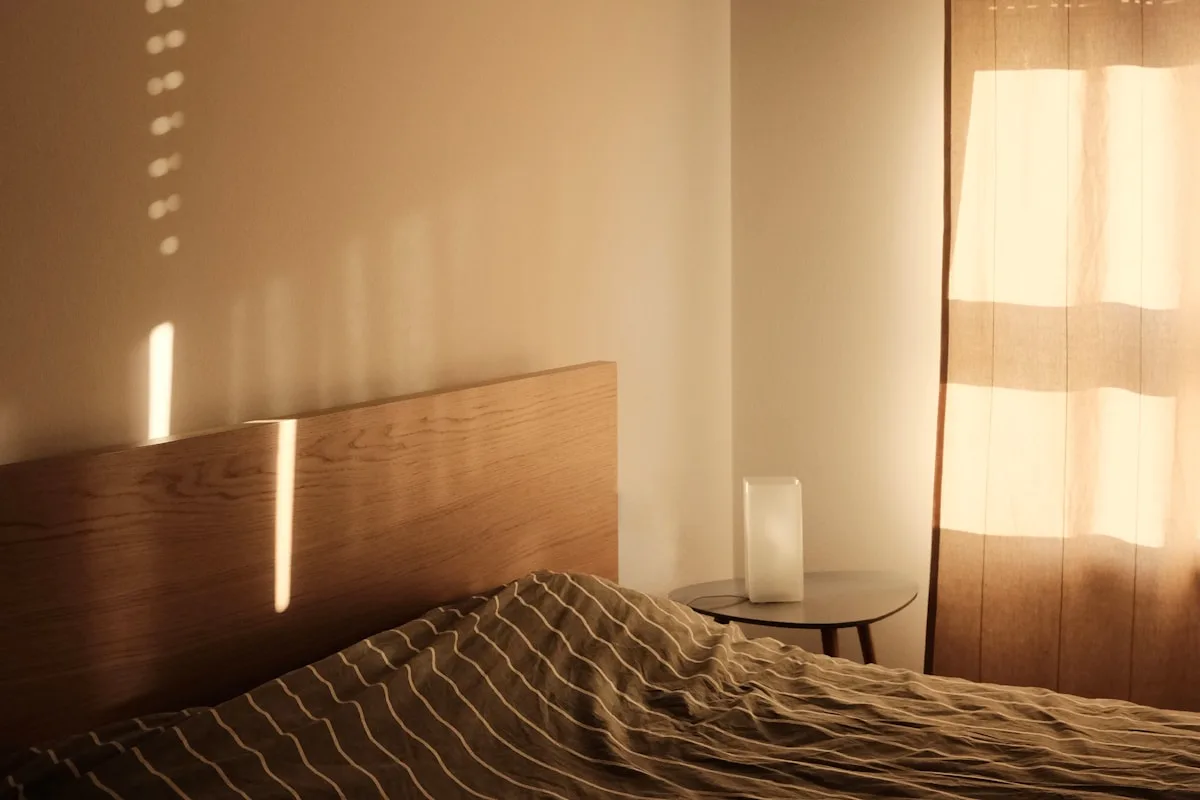
Weekdays: up early. Weekends: sleep until you wake up. It feels like you're "catching up" on sleep. But to your body clock, it's like changing time zone every Friday and changing back on Sunday.
It's often called social jetlag. And there are good reasons to take it seriously.
What happens in your body
Almost everything in your body runs on a daily rhythm: body temperature, hormones, digestion, when you get tired and when you feel alert. The rhythm is driven by an internal clock that's set by light, but also by habits – when you get up, when you eat, when you turn the lights off.
The clock likes predictability. If you get up at the same time every day, your body learns when morning is coming and starts preparing before you wake. You get tired at roughly the same time every evening, without having to force it.
If the times jump back and forth, the clock never gets a foothold. You get tired at the wrong moments, sleep more lightly and wake up groggier, even if the total hours add up the same.
What the research shows
A British study (Windred et al., Sleep, 2024) followed a very large group of adults in UK Biobank who had worn a movement tracker on the wrist, so sleep could be measured objectively day by day instead of through questionnaires. The researchers calculated how regular each person's sleep was – how similar their sleep and wake times were from one day to the next – and then followed the participants for several years.
The result: people with regular sleep had lower mortality during the follow-up than those with irregular sleep. The interesting part was that regularity was a stronger marker than how long they slept. Sleeping at the same times every day was more clearly linked to health than the number of hours itself.
A population study can't prove cause and effect. But it points to something that's often forgotten: when you sleep seems to matter a great deal, not just how much.
What to do
The easiest way to get your clock in step is to fix one point in the day, and that point is when you get up.
- Pick a wake-up time that applies every day. Saturday and Sunday too. If you need more sleep at the weekend, go to bed earlier instead of sleeping later.
- Give yourself some margin. It's about roughly the same time, not the exact same minute. The point is that the times shouldn't jump back and forth.
- Get light as soon as you're up. Open the blinds, step onto the balcony, walk to work. Morning light is the strongest tool you have for setting the clock.
- Count backwards to your bedtime. Start from your wake-up time and how many hours you need. Then your bedtime ends up roughly the same every night too.
Make it a habit
Regularity builds on itself. After a couple of weeks with the same wake-up time, many people wake just before the alarm, and evening tiredness arrives on its own.
Log your bedtime and wake-up time in the app. Seeing the times line up – across the weekend too – is an easier target to aim for than a certain number of hours.

Markus Kask
Health coach & founder of GoMotion
Want to follow this up in everyday life?
The GoMotion app helps you build habits around sleep, movement, nutrition and focus – one step at a time.
Get the app