You're forty-two. Your fitness age is thirty-four.
Or fifty-six. Either way it means the same thing: your oxygen uptake sits where the average thirty-four-year-old — or fifty-six-year-old — sits. Your body has an age of its own, and it has nothing to do with your birthday.
It sounds like a gimmick. It isn't.
What the number is built on
Fitness age is another way of expressing maximal oxygen uptake, VO₂max — how much oxygen your body can take in and use when you're working as hard as you can. It's the single best measure of cardiovascular fitness there is.
Measuring it properly takes a lab, a treadmill and a mask. But it can be estimated well enough without, and that's where fitness age comes in: your estimated VO₂max compared with the average for each age. Land where the average thirty-four-year-old sits, and your fitness age is thirty-four.
The model behind the most widely used calculation comes from the HUNT study in Norway, where several thousand adults aged 20 to 90 had their oxygen uptake measured on a treadmill. Researchers then built a formula that reproduces the lab result from things you can measure at your kitchen table: age, waist or BMI, resting heart rate, and how much you move.
Why fitness specifically
Because its link to how long you live is unusually strong.
The same research group ran their model on 37,000 people from the original HUNT study in the 1980s and followed them for twenty-four years. The risk of dying from cardiovascular disease was 21 per cent lower for every step of 3.5 ml of oxygen per kilo per minute — one MET.
That's a small improvement in fitness. Roughly the difference between not moving at all and walking regularly.
What the number doesn't say
It measures one thing. Fitness. Not strength, not mobility, not balance. You can have an excellent fitness age and still not be able to get off the floor without using your hands.
It's an estimate. The formula is built on a Norwegian population and reconstructs a lab value from four inputs. Good enough to track over time, not precise enough to argue about two years either way.
It's an average, not a fate. A fitness age above your real age means you're below average for your age group — not that you have fewer years left.
What makes it useful
Fitness is the most trainable number you have.
Weight moves slowly and unpredictably. Blood markers need a clinic. But fitness responds to training within weeks, and it responds most in the people with the furthest to go. Going from no movement at all to three walks a week shifts your fitness age more than an experienced runner gains from adding a session.
That's what makes the number worth having: it rewards whoever has the most to gain.
How to find yours
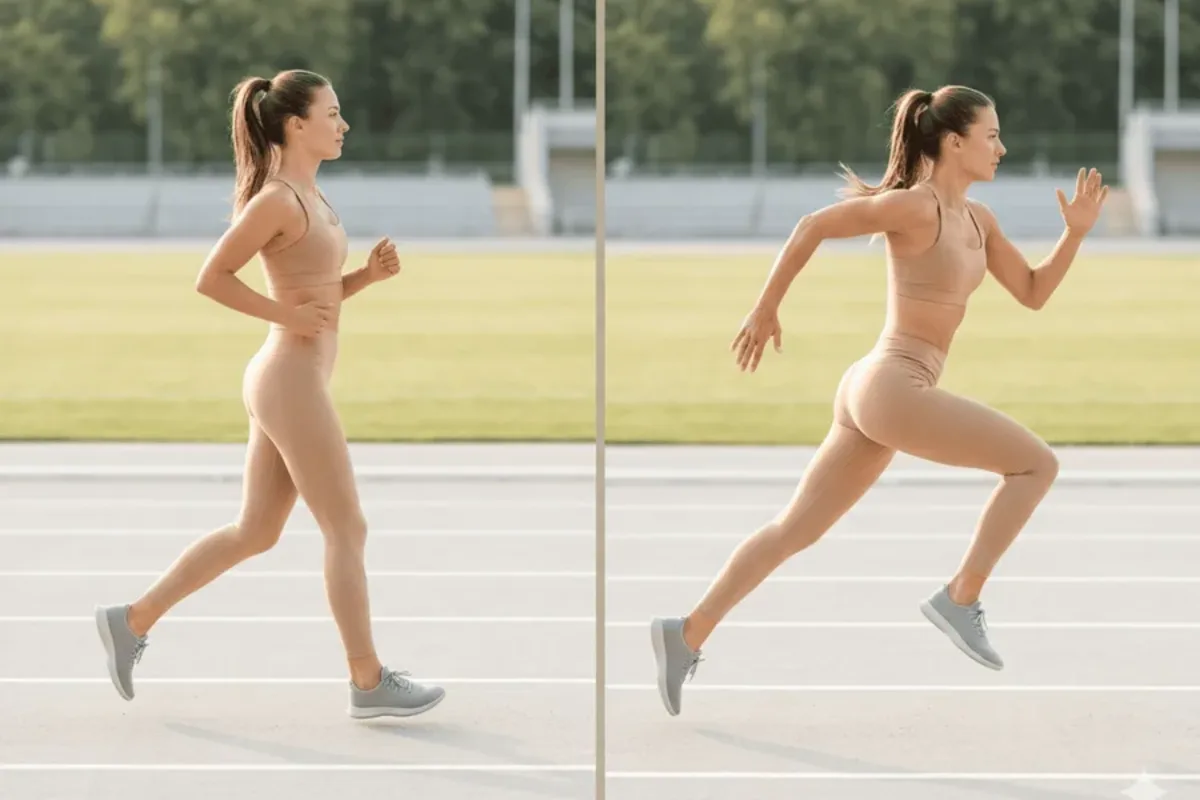
You need a test that pushes you properly. The classic is the Cooper test — run as far as you can in twelve minutes, on flat ground. The distance converts to estimated oxygen uptake, which is compared against age norms.
If you can't run for twelve minutes, the six-minute walk test is the alternative. Less precise, but it gives you a starting point.
Take the test, note the number, train for twelve weeks, take it again. It's the comparison that matters — not whether you landed on thirty-four or thirty-six the first time.
In GoMotion, the Cooper test is one of eight longevity tests. The result gives you your fitness age, feeds into your longevity score, and the program you get trains whichever area is weakest.

Markus Kask
Health coach & founder of GoMotion
Want to follow this up in everyday life?
The GoMotion app helps you build habits around sleep, movement, nutrition and focus – one step at a time.
Get the app