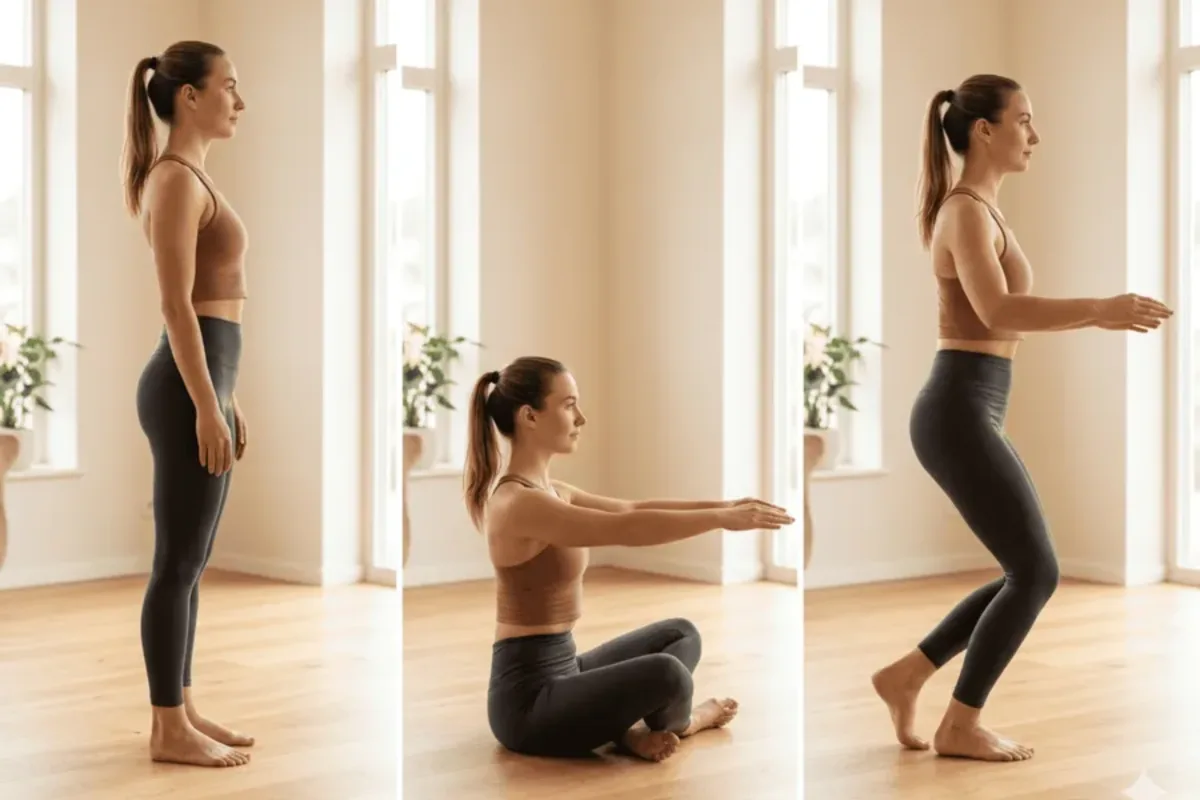
Sit down on the floor. Stand back up. Use as little support as you can.
That's the whole test. It takes half a minute, needs no equipment, and there's research linking the result to how long you live. You've probably seen it online — usually a video of someone lowering themselves cross-legged and standing up again without touching the floor.
That version isn't what the research measured. But the test itself is worth doing.
What the test is
You start with ten points — five for sitting down, five for standing up. Every time you use a hand, a forearm, a knee or the side of your leg, one point comes off. Visibly losing balance costs half a point.
The instruction in the study was not "no hands". It was: sit down and rise using the minimum support you believe you need. That distinction matters. It's what made it possible to run the test on two thousand people aged 51 to 80 without anyone getting hurt.
What the research shows
A Brazilian study (Brito et al., European Journal of Cardiovascular Prevention & Rehabilitation, 2012) put 2,002 people aged 51 to 80 through the test and followed them for just over six years. During that time 159 of them died.
The finding held after the researchers adjusted for age, sex and body mass: those scoring lowest had five to six times the mortality of those scoring highest.
A follow-up study in 2025 in the European Journal of Preventive Cardiology pointed the same way, linking low scores to both natural and cardiovascular causes of death.
Three things the study doesn't say
This is where most articles about the test go wrong.
It doesn't measure one thing. Getting down to the floor and up again needs leg strength, hip and ankle mobility, balance, and a body weight that isn't in the way. The score is all of that combined, not a measure of any one of them.
It doesn't prove cause. That physically capable people live longer is not news. The test is a cheap marker for something already true — not evidence that training away one point of deduction adds years to your life.
It was done on one population. The study came from a single centre in Brazil. In cultures where people sit on the floor daily, scores are higher without those people necessarily being healthier.
Take the test for what it is: a fast way to notice something you wouldn't otherwise notice until it became a problem.
How to do it
- Clear a space with a soft surface and nothing to hit.
- Stand barefoot, arms at your sides.
- Sit down on the floor using as little support as possible. Not fast — controlled.
- Stand back up, still using the minimum support.
- Count: ten points, minus one per support, half a point per visible wobble.
Skip it if your knees or hips hurt, or if you feel unsteady standing up in everyday life. There are better ways to measure this then.
What to do with the number
A low score doesn't mean something is wrong with you. It means one of the parts — leg strength, mobility or balance — has fallen behind, and all three are trainable at any age.
The value is in retesting. Do it today, train for twelve weeks, do it again. The score moves more slowly than the weight on the bar, but it moves — and it says something about what your body can do on the day you need it to.
In GoMotion, the sitting-rising test is one of eight longevity tests. The result is saved, combined with the others into a single score, and the program you get trains whatever is weakest.

Markus Kask
Health coach & founder of GoMotion
Want to follow this up in everyday life?
The GoMotion app helps you build habits around sleep, movement, nutrition and focus – one step at a time.
Get the app