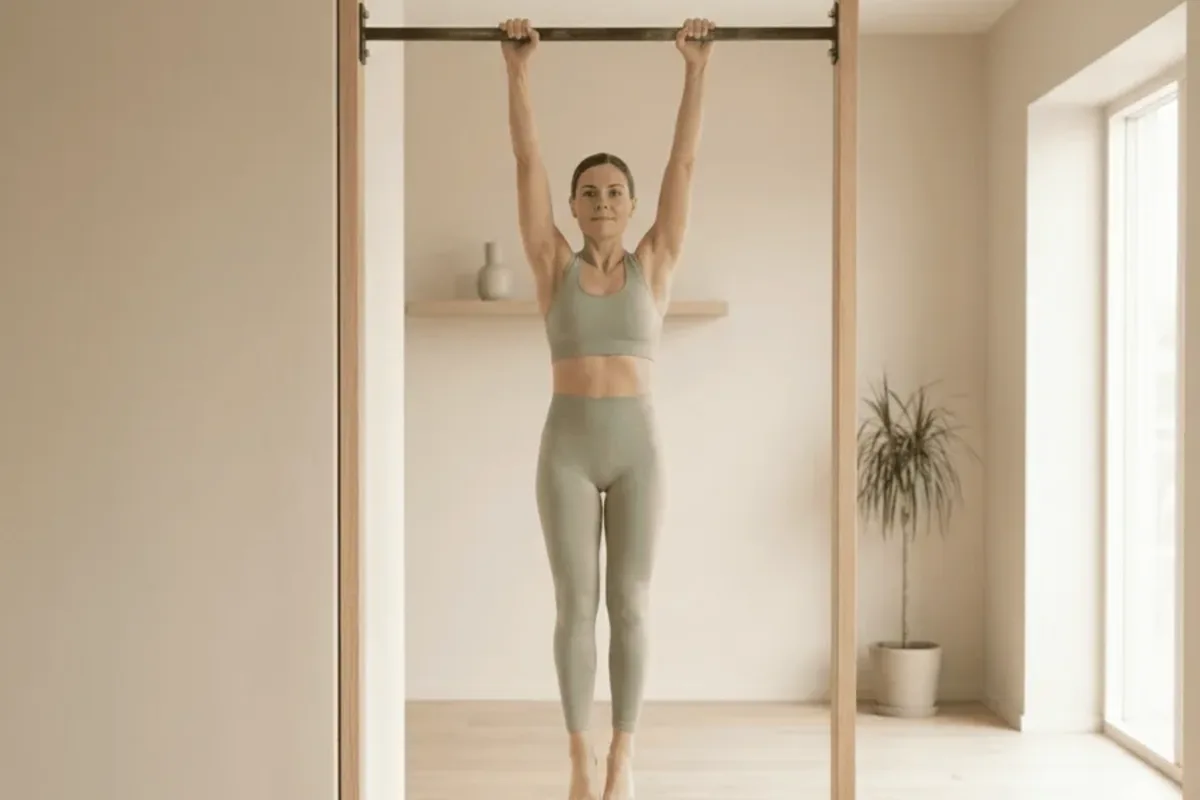
Hang from a bar until you can't hold on. Take the time.
It's one of the simplest tests there is, and one of the most informative. Not because hanging strength matters in itself — it doesn't — but because your grip happens to be a window into something bigger.
Why the grip
Hand strength is measured routinely in large health studies, for a simple reason: it's quick, it needs one device, and the number is hard to fake.
And the associations that come out are unusually strong. In an international study of nearly 140,000 people across seventeen countries (Leong et al., The Lancet, 2015), lower grip strength was linked to higher mortality and higher cardiovascular risk. In that study grip strength was a stronger marker for death than systolic blood pressure.
That doesn't mean your hand matters more than your heart. It means grip picks up something broad — total muscle mass, general strength, how well your nervous system recruits muscle, and by extension how much you've moved through life.
What a hang measures
A hang test isn't quite the same as a hand dynamometer, but it measures related things and needs no equipment at all.
Hanging works your forearms, but also your shoulders, back and trunk. That's why the time drops so fast when any of them lag. People who train regularly but never hang are often surprised how short their time is.
The hang also says something about shoulder mobility. If you can't hang straight with relaxed arms, that's information in itself.
What a hang test isn't
It's a marker, not a cause. Training your hang up to two minutes doesn't automatically make you healthier. What makes you healthier is the strength work that makes the hang longer.
It isn't for everyone. If your shoulders, elbows or wrists hurt, skip it. There are other ways to measure strength.
The number isn't a competition. The spread between individuals is wide and depends partly on body weight. What matters is your own curve, not how you compare with someone else.
How to do the test
- Find a bar you can hang from freely, feet off the floor.
- Take a shoulder-width grip, palms facing forward.
- Drop into the hang with straight arms. Shoulders can relax.
- Time it until you let go. No swinging, no tricks.
Unlike hand strength, which has age norms from large population studies, there are no established reference values for hang time. So don't compare your number with anyone else's — body weight, arm length and grip width affect it too much. Compare it with your own from last time.
How to train it
Grip strength responds fast, often within a few weeks.
- Hang daily. Thirty seconds, two or three times. That's enough.
- Carry heavy things. Walk with a heavy bag in each hand, as far as you can.
- Pull. Rows, lat pulldowns and eventually pull-ups build grip along the way.
The good thing about the hang is that it takes a minute and works anywhere there's a bar — a playground will do.
In GoMotion, the dead hang is one of eight longevity tests. The time is saved, combined with the others into a single score, and the program you get trains whichever area is weakest.

Markus Kask
Health coach & founder of GoMotion
Want to follow this up in everyday life?
The GoMotion app helps you build habits around sleep, movement, nutrition and focus – one step at a time.
Get the app